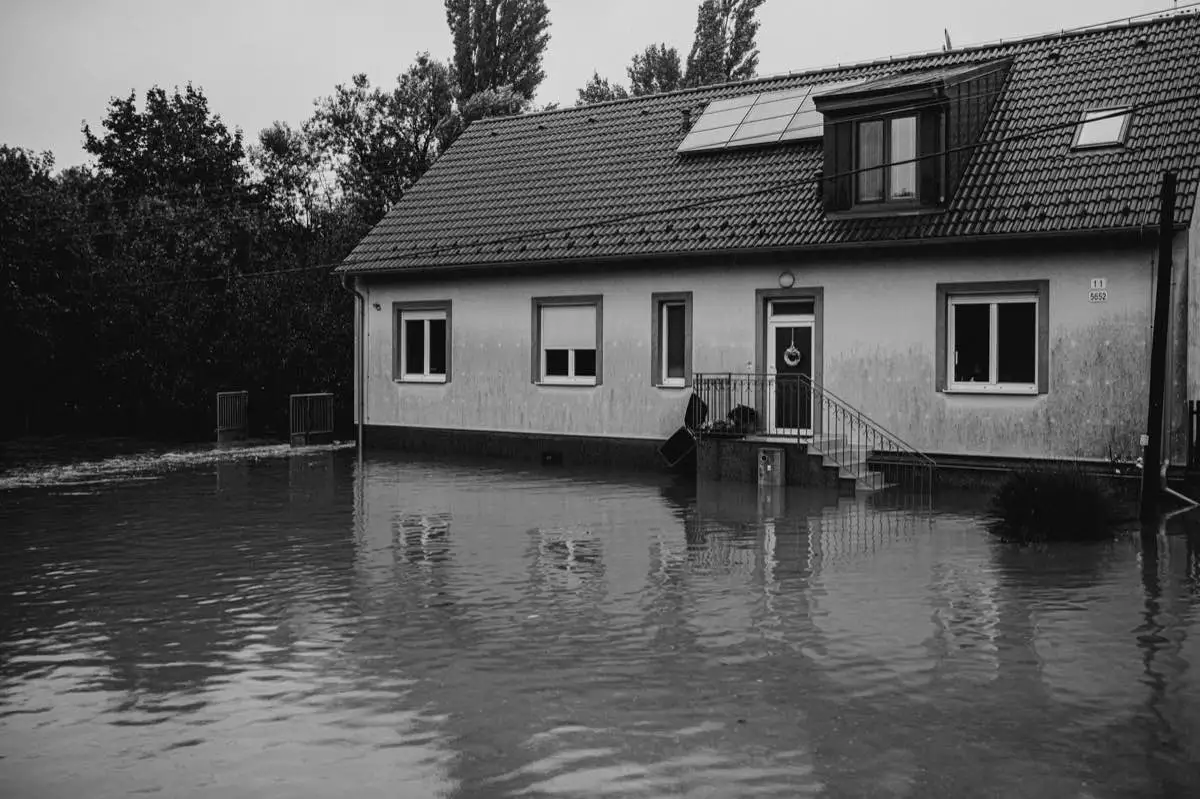
The clearest signs of water damage in a house are a musty smell that keeps coming back after you clean, a stain that changes shape or size between visits, and floors or drywall that feel soft, spongy or oddly cool to the touch. Everything else on the list supports those three. Houses are not good at asking for help. They mostly just smell a bit odd and wait for somebody to notice.
Timing is why this matters. Restoration splits into two prices — drying things out, and tearing things out — and the line between them sits at roughly 24 to 48 hours of sustained moisture, the window the industry uses for when mold starts on damp drywall paper and wood.
The signs you can see
Sight is the least reliable sense here — by the time water shows on a finished surface it has been traveling a while. Still, these are what people notice first.
- Stains with a defined edge. A brown or tan ring with a hard outer edge means the water advanced and stopped. A soft, fuzzy edge often means it is still moving.
- Bubbling, peeling or blistering paint. Latex paint acts as a vapor barrier. When moisture pushes from behind, it lifts the film off the drywall in a bubble.
- Cracked or crumbling drywall tape at a seam, especially on a ceiling.
- Baseboards and casings pulling away from the wall. MDF swells at the bottom edge first and never goes back.
- Cupped or crowned flooring. Hardwood boards that dish in the middle are cupping from moisture underneath, and laminate that lifts at the seams has already delaminated.
- Rust on nail heads, hinges, or the base of a water heater. Metal is an honest witness.
Useful trick: draw a light pencil line around the stain and write the date beside it. Check it in 48 hours. If it crosses the line, the leak is active. If it has not moved in two weeks, you are probably looking at history.
The signs you can smell
Your nose is the cheapest moisture detector you own and it never needs batteries. That damp, earthy, slightly sweet basement smell is a byproduct of microbial growth feeding on wet paper, wood and dust. It is not "old house smell." It is a reading.
Two patterns worth knowing. A smell that gets stronger when the HVAC kicks on usually means the moisture sits in a duct, the air handler pan, or a wall cavity the return is pulling air through. A smell that is worse in one closet or one corner is telling you exactly where to point the meter.
The EPA and CDC note that mold can cause allergic reactions and respiratory irritation in sensitive people, so if somebody has allergies that flare in one specific room, raise it with a doctor as well as investigating the room.
The signs you can feel
Touch catches what sight misses. Press a thumb into drywall about six inches above the baseboard. Dry drywall is firm and slightly springy. Wet drywall gives, and sometimes holds the dent.
Walk the floor in socks. Carpet that feels cool and heavy underfoot, or a hallway spot that flexes more than the rest of the run, is holding water in the pad or subfloor. A tile floor with two or three hollow-sounding tiles in a row usually means the substrate under them has been wet.
Where hidden water damage actually hides
The visible wet spot is rarely the whole story, because drywall paper wicks moisture upward and water tracks sideways along framing before it drops. Here is where Ontario Water Restoration Pros crews look first on a Ontario walkthrough, room by room.
| Room | What to check | What you are looking for |
|---|---|---|
| Kitchen | Under-sink cabinet floor, dishwasher toe kick, fridge line | Swollen particleboard, dark rings, a soft toe kick |
| Bathroom | Grout at the tub edge, toilet base, the shared wall behind the shower | Loose grout, a rocking toilet, a stain on the far side of that wall |
| Laundry | Supply hoses at the washer, the drain standpipe | Rubber hoses over five years old, corrosion at the fittings |
| Attic | Sheathing around penetrations, the underside of valleys | Dark staining, rusty nails, matted insulation |
| Basement or crawl | Rim joist, the base of exterior walls | Efflorescence, a tide line, musty air |
| Water heater | The drip pan, the floor at the base, the discharge pipe | Rust on the tank bottom, mineral crust on fittings |
Thermal imaging cameras get used constantly here, and they are useful, but here is the part plenty of companies gloss over: a thermal camera reads temperature differences, not moisture. Wet material reads cooler because it is evaporating, which is why the camera finds it, but a cold draft looks nearly identical on screen. Every thermal finding gets confirmed with a moisture meter before anyone cuts drywall.
How to check it yourself for about $40
A pinless moisture meter runs roughly $30 to $60 at any hardware store and takes ten seconds to learn.
- Take a reading on the same material in a part of the house you know is dry. That number is your dry standard.
- Read the suspect area in a grid, working outward until the numbers drop back to the dry standard. That outline is the real wet area, and it is almost always bigger than the stain.
- Read it again 24 hours later. Falling means it is drying. Flat means air is not reaching it. Climbing means water is still arriving.
That third reading is the entire diagnosis. Most people skip it and guess.
When you should not call anyone
Being straight about this costs us work and it is still the right answer. Let the meter decide. A clean-water spill smaller than roughly 10 square feet, on a hard sealed surface, caught inside a couple of hours and never in contact with drywall or carpet pad, is a towel and an overnight fan. Read it at 24 hours. If the number matches your dry standard, you are finished. Nobody needs to come out.
Same with a single old ceiling stain that has been unchanged for years and passes the pencil-line test. That is cosmetic. Seal it with stain-blocking primer, paint it, move on.
And if you can see and reach the drip, that is a plumber, not a restoration company. Fixing the source is a different trade from drying the building, and plenty of Ontario calls we take are really a $15 supply line and a wrench.
When it stops being a DIY question
Call a crew if the water reached drywall, carpet pad, insulation or subfloor; if it sat more than 24 hours; if it came from a toilet, a washing machine, sewage or outside ground water; if you can smell must; or if your meter readings are flat or climbing after a full day of fans. Those are the cases where professional water extraction and metered drying beat a box fan by a wide margin, and where ignored moisture in a cavity turns into a mold remediation bill a month later.
If the source is a failed supply line or a split pipe inside a wall, you need burst pipe repair before anybody talks about drying. You cannot dry a building that is still filling up.
The bottom line
The three signs that matter are smell, movement and softness — a musty odor that returns, a stain that grows past a pencil line, and material that gives under a thumb. Confirm any of them with a meter reading against a dry standard of the same material rather than with your hand, because a wall can feel perfectly dry while the cavity behind it is soaked. For what happens after the visible water is gone, we covered the humidity side in secondary water damage, and the specific case of an overhead leak in ceiling water damage.
If your readings are not dropping, or that smell is back for the third time, Ontario Water Restoration Pros will walk it with meters and hand you the numbers in writing, across Ontario and the Inland Empire. No pressure to start work you do not need. Call (855) 514-1094.
Ready for a free quote in Ontario?
Ontario Water Restoration Pros — free estimate, clear scope, no pressure. Use the form on this page or jump to the homepage quote.
Related services in Ontario
Ontario Water Restoration Pros money pages — go straight to the service you need.
- Emergency Water Extraction & Removal →
Extraction is the hour that decides the whole loss. Every gallon pulled out with a pump or a wand is a gallon no dehumidifier has to evaporate later, and in a building running two shifts that difference is measured in days you stay open.
- Burst Pipe & Supply Line Failures →
A broken pipe in a single-story house is a bad afternoon. The same failure in a stacked building is three losses, three tenants and three adjusters, because water leaves the unit it started in within minutes and does not come back.
- Mold Remediation & Containment →
Remediation in an occupied building is mostly a containment problem. The removal itself is straightforward.
- Structural Drying & Dehumidification →
Drying is a math problem before it is a labor problem. You are moving water out of concrete, gypsum and framing into air, and then out of the building.
- Flood & Standing Water Cleanup →
Almost nothing we are called a flood for in Ontario is a flood in the insurance sense. The water is deep, standing and moving, but it came out of the building's own plumbing, and that distinction decides which policy pays.
Frequently asked questions
What are the first signs of water damage in a house?
A musty smell that returns after you clean, a stain that changes shape between visits, and floors or drywall that feel soft or spongy underfoot. Peeling paint, bubbling wallpaper and swollen baseboards usually show up in the same week. Any one of them means moisture is present right now, not that it happened once.
Can water damage hide behind walls?
Yes, and that is where most of it lives. Drywall paper wicks water upward through the cavity, so the wet part is often 12 to 18 inches above the wet part you can see. A pin-type moisture meter, or a look behind a removed outlet cover, settles it in about a minute.
Does a musty smell always mean mold?
Not always, but it always means moisture. That earthy basement smell is the gas microbial growth gives off as it feeds on damp paper and wood. Air freshener covers the smell and changes nothing, so treat the odor as a reading rather than a nuisance.
How can I check for water damage myself?
Buy a pinless moisture meter for about $30 to $60, take a reading on a wall or floor you know is dry, then compare every suspect spot against that number. Anything meaningfully higher is wet. Repeat the reading 24 hours later to see whether it is drying, holding steady or climbing.
How long can water sit before it becomes a serious problem?
The industry treats 24 to 48 hours of sustained moisture as the point where mold growth begins on drywall paper and wood, and where clean water starts degrading into dirtier categories. Inside that window you are usually drying things. Outside it, you are usually replacing them.
Is a water stain on the ceiling always serious?
No. An old stain that has not changed shape, shade or size across several seasons is a scar left by a leak somebody already dealt with. One that creeps past a pencil mark you draw around it, gets darker, or starts to sag is live, and the source has to be found before anything gets painted.
Local context
How this applies in Ontario, CA
Every article here is written from water damage work done in Ontario and the Inland Empire, so the numbers reflect local labour, permit and material costs rather than a national average. Your own job can land either side of them depending on access, the condition of what is already there, and the materials you pick — desiccant dehumidifiers for large open volumes, low-grain refrigerant dehumidifiers, HEPA-filtered negative air machines.
The way to turn any of this into a real answer is to have someone look at your actual situation. The free estimate is free, itemized and written down, with no deposit and no obligation. Call (855) 514-1094 or start on the Ontario Water Restoration Pros homepage.
Areas Ontario Water Restoration Pros covers
Ontario first, then the surrounding communities of the Inland Empire. Each has its own page with local detail rather than a copy of this one:
- Chino, CA — San Bernardino County, incorporated in 1910, population 91,403 at the 2020 census
- Chino Hills, CA — San Bernardino County, incorporated in 1991, population 78,411 at the 2020 census
- Montclair, CA — San Bernardino County, incorporated in 1956, population 37,865 at the 2020 census
- Upland, CA — San Bernardino County, incorporated in 1906, population 79,040 at the 2020 census
- Rancho Cucamonga, CA — San Bernardino County, incorporated in 1977, population 174,453 at the 2020 census
- Fontana, CA — San Bernardino County, incorporated in 1952, population 208,393 at the 2020 census
Or jump to the full list of Ontario services.
More from the Ontario Water Restoration Pros blog
- Mold After Water Damage in Ontario, CA: The 48-Hour Clock
Mold can start within 24 to 48 hours of water sitting. What to dry, what the EPA 10 sq ft rule means, and when to call a pro in Ontario, CA.
- How Long Does Water Damage Take to Dry? Ontario, CA
Surface water dries in 24-48 hours with pro equipment; walls and framing take 3-5+ days. The real water-damage drying timeline for Ontario, CA.
- Burst Pipe Water Damage in Ontario, CA: First Steps
Shut off the main, deal with power safely, photograph everything, then extract. The first-hour order of operations for burst pipes in Ontario, CA.
The Ontario Water Restoration Pros Team
water damage specialists serving Ontario, CA
Written by the Ontario Water Restoration Pros team — insured water damage pros with 15+ years serving Ontario, CA and the surrounding area.