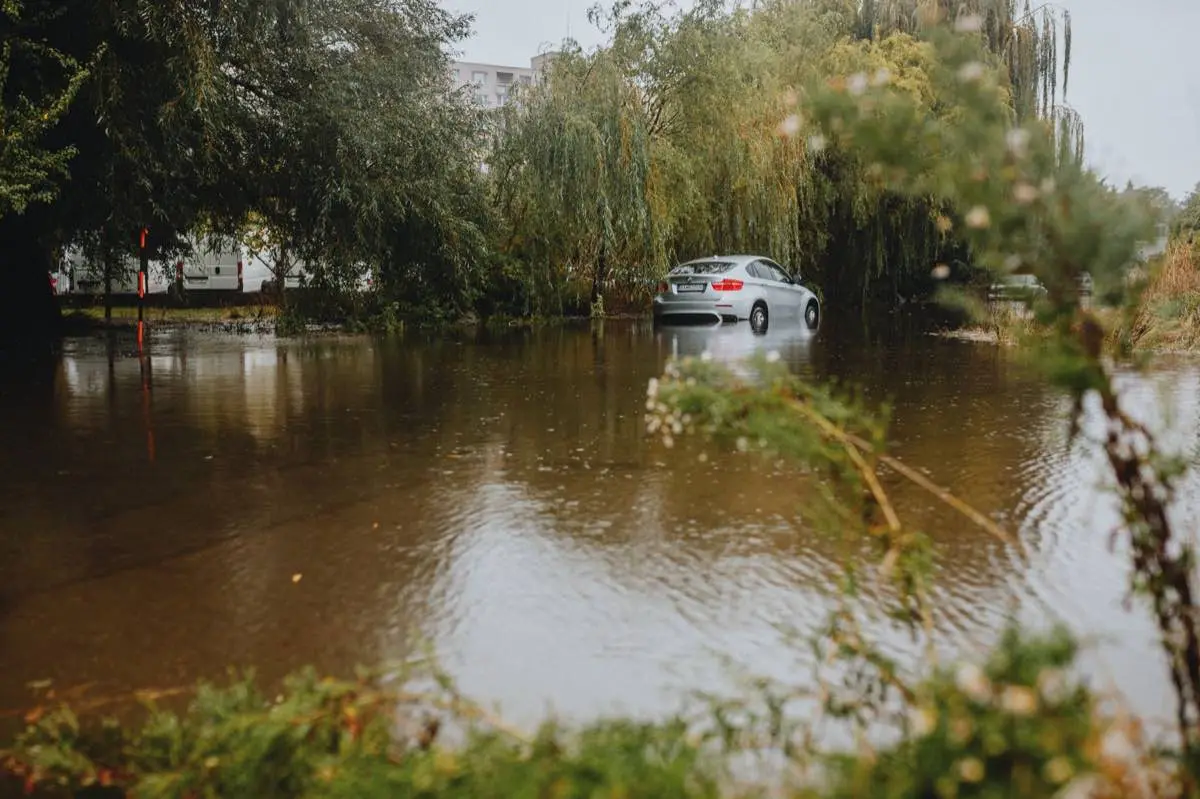
When a pipe bursts, the order is: shut off the main water valve, deal with electricity safely, photograph everything before you touch it, then get the standing water out. Do those four in that sequence and you have already handled the part that decides how big this gets. Water heaters and supply lines have a documented preference for failing on holiday weekends, which is unfortunate, but the sequence does not change.
Here is the number that reframes the panic. A half-inch supply line at ordinary household pressure discharges several gallons a minute. A failure at 1am that nobody catches until 6am is not a spill. It is a few hundred gallons redistributed through your floor, your wall cavities and, if you have a second story, your ceiling.
Step one: kill the water
Find the main shutoff. In most homes it is where the supply line enters — at the meter near the street, on the wall of a basement or crawl space, in a utility closet, or right beside the water heater. Turn it clockwise until it stops.
If the valve is a lever, a quarter turn does it. If it is a round gate valve that has not moved since the house was built, it may take some persuasion, and it may weep afterwards. That is a problem for later.
Go find that valve now, before you ever need it. Two minutes on a calm Sunday beats ten minutes in the dark with water running down a stairwell, and a fair share of the Ontario calls we take start with somebody looking for a valve they have never touched. If you can, also learn where the water heater's cold inlet valve is, because a failed tank is stopped there without shutting the whole house down.
Step two: electricity, and the rule that is not negotiable
Do not walk into standing water to reach a breaker panel. If the panel is dry, reachable without stepping in water, and your hands and shoes are dry, kill power to the affected circuits. If it is not, stop. Call the utility or a licensed electrician and keep everyone out of that space. Ceiling fixtures filling with water and outlets below the waterline are both real hazards, and no amount of saved carpet is worth finding out how real.
Same rule for a sagging ceiling holding water. Stay out from under it.
Step three: photograph before you clean
This is the step people skip, and it is the one they regret. Take photos and video of the water at its worst, before any cleanup, including wide shots of each room, close-ups of the failed pipe or fitting, and shots of everything wet — furniture, boxes, baseboards, the underside of doors.
Then move, because the policy will expect you to have. Standard homeowners forms carry a numbered condition obliging you to protect the property from further damage and to keep an accurate record of what that costs you. We quote the clause itself, and say where it sits in the form, in the water damage insurance claim guide, along with the sudden-discharge versus gradual-seepage distinction most disputes turn on. So: photograph, then act. Keep every receipt — the wet vac rental, the fans, the hotel if the house is unusable.
To be clear about our role: Ontario Water Restoration Pros documents conditions and moisture readings, and we are not the ones who decide what your policy covers. That is between you and your carrier.
Step four: get the water out, then get the air right
Every gallon physically extracted is a gallon the dehumidifiers never have to pull out of the air, which is why extraction is the cheapest water removal there is. A truck-mounted or portable extractor with a weighted wand pulls water out of carpet and pad far faster than any rental unit.
Then the drying starts, and this is where a burst pipe gets interesting. Water from an overhead line that ran through a ceiling and down two walls is typically a Class 3 loss under the IICRC S500 standard — saturated ceilings, walls and insulation, high evaporation load. Water that spread across a tile floor with minimal absorption might be Class 1. The class drives how much equipment shows up and how long it stays.
Wall cavities are the specific challenge. Rather than demolishing every wall the water touched, crews often drill small holes behind the baseline or remove the baseboard and use an injectidry-style system to force air directly into the cavity. Done early on clean water, that keeps your drywall on the wall. Done late, it does not, because the insulation and the back paper are already gone.
Why pipes burst in the first place
| Cause | What is really happening | The tell |
|---|---|---|
| Freezing | Ice forms, and pressure builds between the ice plug and a closed faucet until the pipe splits | Splits appear on the warm side after a thaw, not at the ice |
| Corrosion | Old galvanized or thin-walled copper pinholes from the inside out | Green crust on copper, rusty water, repeated small leaks |
| High pressure | Household pressure above 80 psi stresses every joint and appliance | Banging pipes, short-lived water heaters, weeping fittings |
| Bad material | Gray polybutylene from the late 1970s through mid 1990s failed widely | Gray flexible pipe with crimped fittings |
| Failed connectors | Braided washing machine hoses and toilet supply lines age out | Bulges, rust at the crimp, a hose older than five years |
Two of those are cheap to prevent, and worth an hour of your next Ontario weekend. A pressure gauge that threads onto a hose bib costs about $12, and the International Residential Code caps static supply pressure at 80 psi for a reason — over that, a pressure reducing valve is the fix. And replacing rubber washing machine hoses with braided stainless ones on a five-year cycle is maybe $30 of hardware standing between you and a laundry room full of water.
If the split itself needs fixing rather than just drying, that is a burst pipe repair job, and it has to happen before drying is worth starting.
Where you genuinely do not need us
Straight answer: if a supply line let go under a bathroom sink, you shut it off within a few minutes, and the water stayed on tile inside the vanity and a small area of the floor — under roughly 10 square feet — dry it yourself. Towel it, pull anything out of the cabinet, run a fan into the cabinet overnight, and check it with a $30 moisture meter at 24 hours against a dry spot on the same material. If the reading matches, you are done, and you spent nothing.
Also worth saying plainly: if the whole loss looks like it will land under your deductible, filing a claim can cost you more than it returns. A small clean-water job is often better paid out of pocket.
The bottom line
Burst pipe water damage is a race that is mostly won in the first hour. Shut the main, handle power safely, photograph everything, extract, then dry to a meter reading rather than to how the floor feels. Clean water caught fast is usually a drying job. The same water on day four is usually a rebuild, and the cost gap between those two is the entire reason to move quickly. For what those two versions actually cost, we broke the ranges down in what water damage cleanup costs.
If it is happening right now, Ontario Water Restoration Pros runs emergency water extraction and structural drying around the clock across Ontario and the Inland Empire, and we will tell you honestly if your situation is small enough to handle with a fan. Y si prefieres hacer la llamada en español, la atendemos igual. Call (855) 514-1094.
Ready for a free quote in Ontario?
Ontario Water Restoration Pros — free estimate, clear scope, no pressure. Use the form on this page or jump to the homepage quote.
Related services in Ontario
Ontario Water Restoration Pros money pages — go straight to the service you need.
- Emergency Water Extraction & Removal →
Extraction is the hour that decides the whole loss. Every gallon pulled out with a pump or a wand is a gallon no dehumidifier has to evaporate later, and in a building running two shifts that difference is measured in days you stay open.
- Flood & Standing Water Cleanup →
Almost nothing we are called a flood for in Ontario is a flood in the insurance sense. The water is deep, standing and moving, but it came out of the building's own plumbing, and that distinction decides which policy pays.
- Burst Pipe & Supply Line Failures →
A broken pipe in a single-story house is a bad afternoon. The same failure in a stacked building is three losses, three tenants and three adjusters, because water leaves the unit it started in within minutes and does not come back.
- Structural Drying & Dehumidification →
Drying is a math problem before it is a labor problem. You are moving water out of concrete, gypsum and framing into air, and then out of the building.
- Storm & Wind-Driven Rain Damage →
Ontario does not get hurricanes, and pretending otherwise helps nobody. What we get is a few very wet days a year landing on flat roofs that were built to shed water through a drain, plus Santa Ana wind events that pull at membrane seams and flashing.
Frequently asked questions
What is the first thing to do when a pipe bursts?
Shut off the main water valve, then deal with electricity. The main is usually where the supply enters the house, at the meter, or near the water heater. Turning it off stops the damage from growing, and everything else you do afterwards is worth more once the water has stopped arriving.
Should I turn off the electricity if a pipe bursts?
Only if you can reach the panel without standing in water and your hands and footing are dry. If the panel is in a wet basement or the water is anywhere near outlets or the service equipment, do not wade in. Call your utility or a licensed electrician and stay out of that area until somebody clears it.
How much water comes out of a burst pipe?
A half-inch supply line at normal household pressure puts out several gallons a minute, so an overnight failure can move hundreds of gallons through a floor before anyone wakes up. That is why the shutoff matters more than the mopping. The volume is also why burst pipes so often become multi-room losses.
Is burst pipe water damage covered by homeowners insurance?
Sudden and accidental discharge from a plumbing system is commonly covered, while long-term seepage from a leak that was left alone usually is not. We do not decide coverage and neither does any restoration company. Read your declarations page or ask your adjuster, because the terms vary policy to policy.
Do I need to replace drywall after a burst pipe?
Not always. Clean Category 1 water caught quickly can often be dried in place with wall-cavity drying equipment, which keeps the drywall on the wall. Drywall usually comes out when it stayed wet for days, when insulation behind it is saturated, or when the water was Category 3.
How long does burst pipe restoration take?
Extraction typically happens on day one, structural drying commonly runs 3 to 5 days with daily meter readings, and any repairs start after that. Hardwood, plaster and concrete can push the drying phase longer. Nobody can give you a firm total before somebody has taken moisture readings in your house.
Local context
How this applies in Ontario, CA
Every article here is written from water damage work done in Ontario and the Inland Empire, so the numbers reflect local labour, permit and material costs rather than a national average. Your own job can land either side of them depending on access, the condition of what is already there, and the materials you pick — desiccant dehumidifiers for large open volumes, low-grain refrigerant dehumidifiers, HEPA-filtered negative air machines.
The way to turn any of this into a real answer is to have someone look at your actual situation. The free estimate is free, itemized and written down, with no deposit and no obligation. Call (855) 514-1094 or start on the Ontario Water Restoration Pros homepage.
Areas Ontario Water Restoration Pros covers
Ontario first, then the surrounding communities of the Inland Empire. Each has its own page with local detail rather than a copy of this one:
- Chino, CA — San Bernardino County, incorporated in 1910, population 91,403 at the 2020 census
- Chino Hills, CA — San Bernardino County, incorporated in 1991, population 78,411 at the 2020 census
- Montclair, CA — San Bernardino County, incorporated in 1956, population 37,865 at the 2020 census
- Upland, CA — San Bernardino County, incorporated in 1906, population 79,040 at the 2020 census
- Rancho Cucamonga, CA — San Bernardino County, incorporated in 1977, population 174,453 at the 2020 census
- Fontana, CA — San Bernardino County, incorporated in 1952, population 208,393 at the 2020 census
Or jump to the full list of Ontario services.
More from the Ontario Water Restoration Pros blog
- Water Damage Insurance Claim Steps in Ontario, CA
Document before cleanup, mitigate, then notify your carrier. How a water damage insurance claim actually works for homeowners in Ontario, CA.
- What Is Secondary Water Damage in Ontario, CA Homes?
Secondary water damage is what high humidity ruins after the water is gone: cupped floors, swollen MDF, musty cavities. How to stop it in Ontario, CA.
- Emergency Water Extraction Process in Ontario, CA
Safety check, stop the source, extract, set drying, monitor daily, document. What emergency water extraction really involves in Ontario, CA homes.
The Ontario Water Restoration Pros Team
water damage specialists serving Ontario, CA
Written by the Ontario Water Restoration Pros team — insured water damage pros with 15+ years serving Ontario, CA and the surrounding area.