Water damage gets sorted into three categories, and the category decides almost everything about how the job runs. Category 1 is clean water from a supply line or tank, Category 2 is gray water from an appliance or a toilet overflow with no solids, and Category 3 is black water from sewage, ground surface water or a flooded river. The classification comes from the IICRC S500 Standard for Professional Water Damage Restoration, which is the reference document the whole trade works from.
One thing to get out of the way first, because people take it personally: the category is about where the water came from and what is living in it, not a grade on your housekeeping. A spotless house with a sewer backup has Category 3 water. That is just how the standard works.
Category 1: clean water
Water from a source that does not pose a substantial health risk on contact. Think a broken copper supply line, a burst water heater tank, a failed toilet supply line above the trap, melting ice, or rainwater that came straight in through a roof penetration.
This is the good news category, and it is what most Ontario calls start as. Clean water can very often be dried in place — the carpet stays, the pad might survive, the drywall stays on the wall. That is the cheapest version of this job by a wide margin, and it is only available for a limited time.
Category 2: gray water
Water carrying meaningful contamination that could cause discomfort or illness if somebody ingested it. The usual sources are a washing machine discharge, a dishwasher overflow, a toilet overflow containing urine but no solids, or a punctured waterbed.
Category 2 changes the response. Carpet may be salvageable, but the pad usually is not — it is a sponge that holds contaminated water and there is no reliable way to clean the inside of it. Antimicrobial application becomes part of the job rather than an upsell.
Category 3: black water
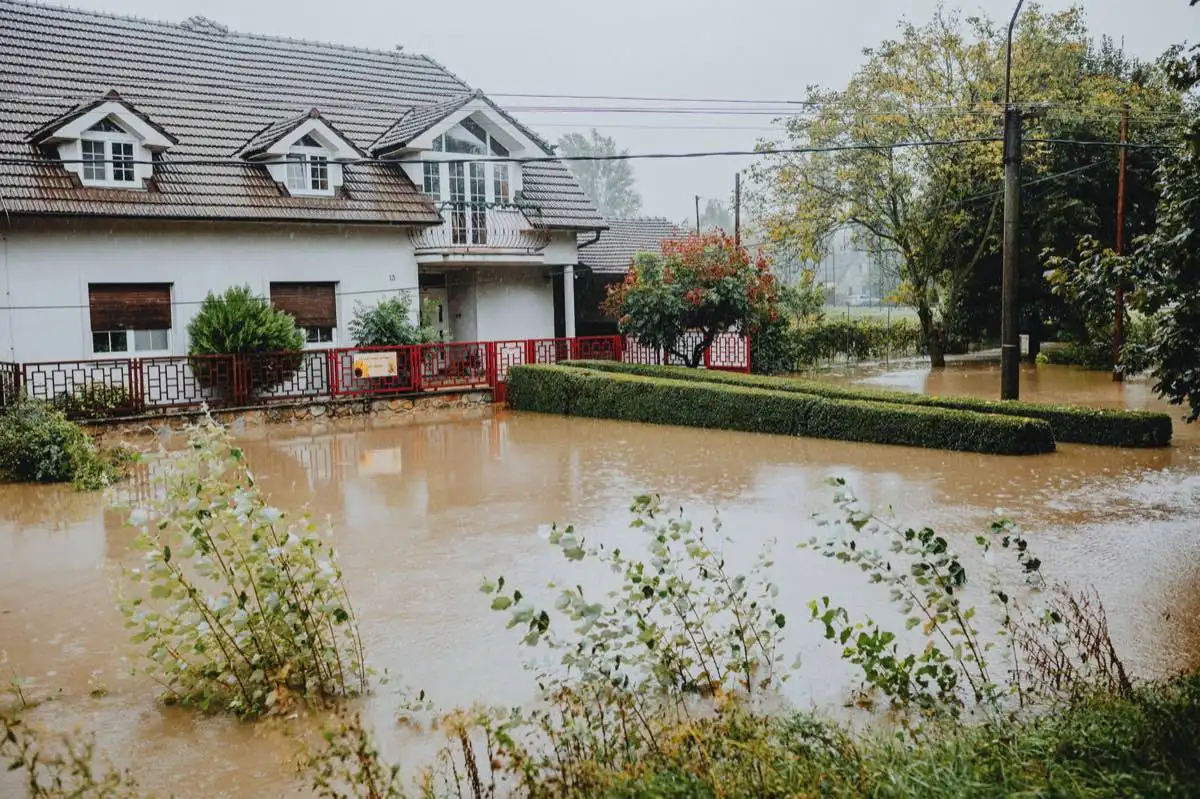
Grossly contaminated water. Sewage backups, water from beyond a toilet trap that contains solids, water from a septic system, rising ground surface water, river or stream flooding, and wind-driven storm water that crossed contaminated ground all land here.
Category 3 is not a drying job with extra steps. Porous material that black water touched comes out — carpet, pad, saturated drywall, insulation, particleboard, upholstered furniture. Crews work in personal protective equipment behind containment with negative air pressure, hard surfaces get cleaned and disinfected, and the affected material leaves the property in bags. If your water came from a backup, that is a sewage cleanup job from the first minute, and if it came from outside flooding it is flood damage cleanup.
The rule that costs people real money
Here is the part almost nobody knows, and it is the single most expensive fact in this article. Category 1 water does not stay Category 1 out of loyalty. It degrades.
Clean water sitting on a carpet pad, soaking into drywall, and warming up to room temperature picks up soil, dust, cellulose and whatever else is on the floor, and it starts growing microbial life. The industry commonly treats that degradation as happening within 24 to 48 hours, faster when it is warm.
So the same burst pipe produces two completely different jobs depending on nothing but the clock:
- Caught in hours: Category 1, extract and dry in place, carpet and drywall stay, lower end of the bill.
- Caught on day three: effectively Category 2, pad comes out, drywall may come out, antimicrobial treatment, higher bill and a longer job.
That is not a sales pressure tactic, it is just how contamination works. If you want the actual dollar difference between those two versions, the ranges are in what water damage cleanup costs.
Category is not the same as class
These two get mixed up constantly, including by people in the trade who should know better. Category describes how dirty the water is. Class describes how much material is wet and how hard it will be to dry. Both come from S500 and both appear on a proper scope.
| Class | What it means | Typical scene |
|---|---|---|
| Class 1 | Least absorption, under roughly 5 percent of the combined floor, wall and ceiling area is wet | A small spill on tile, minimal porous material |
| Class 2 | Significant absorption into carpet, pad and cushion; wicking up walls under about 24 inches | A room of soaked carpet |
| Class 3 | Water came from overhead; ceilings, walls, insulation and subfloor are saturated | An upstairs supply line that ran all night |
| Class 4 | Deeply held or bound water in low-evaporation materials | Hardwood, plaster, concrete, stone, crawl space |
Class is what drives the equipment count and the schedule, and it is the first thing Ontario Water Restoration Pros establishes on a walkthrough. A Class 1 clean-water loss might need two air movers and one dehumidifier for three days. A Class 4 loss with bound water in hardwood or concrete needs specialty systems and patience, and it is the case where desiccant dehumidification often beats a standard refrigerant unit.
What the category actually changes on your invoice
- Protective equipment and containment. Category 3 means suits, respirators, poly barriers and negative air. That is labor and materials.
- What gets thrown away. Drying is cheap. Removal, disposal and rebuild are not.
- Antimicrobial application. Standard for 2 and 3, generally unnecessary for clean Category 1.
- Time on site. More removal means more days, and equipment stays in a Ontario home typically 3 to 5 days regardless of category.
- Verification. Category 3 work often warrants third-party clearance before rebuild starts.
When the category means you can skip the phone call
We would rather be useful than booked. If the water is Category 1, the affected area is under about 10 square feet, it is on tile or a sealed hard floor, and you caught it within a couple of hours — handle it yourself. Towel it up, run a fan, and check it at 24 hours with a moisture meter against a dry spot of the same material. That is a complete job and it costs you nothing but an evening.
The line moves the second any of those change. Category 2 or 3 water of any size, any Category 1 water that reached carpet pad or drywall, or anything that has been sitting more than a day is a different conversation, because now you are removing contamination rather than removing water.
The bottom line
Category 1 is clean, Category 2 is gray, Category 3 is black, and the only one of those you get to keep for free is Category 1 — and only for about a day or two. Class tells you how hard the drying will be, category tells you how dirty the job is, and the two together are what a real scope is built on. The damage that shows up afterwards from humidity rather than from the water itself is a separate topic we covered in secondary water damage.
If you are not sure which category you are looking at, treat it as the worse one and stay out of it. Ontario Water Restoration Pros identifies the category, documents it, and scopes water extraction accordingly across Ontario and the Inland Empire. Call (855) 514-1094 and you will get a straight read, including if the answer is that you do not need us.
Ready for a free quote in Ontario?
Ontario Water Restoration Pros — free estimate, clear scope, no pressure. Use the form on this page or jump to the homepage quote.
Related services in Ontario
Ontario Water Restoration Pros money pages — go straight to the service you need.
- Emergency Water Extraction & Removal →
Extraction is the hour that decides the whole loss. Every gallon pulled out with a pump or a wand is a gallon no dehumidifier has to evaporate later, and in a building running two shifts that difference is measured in days you stay open.
- Flood & Standing Water Cleanup →
Almost nothing we are called a flood for in Ontario is a flood in the insurance sense. The water is deep, standing and moving, but it came out of the building's own plumbing, and that distinction decides which policy pays.
- Sewage & Category 3 Water Cleanup →
Category 3 water is defined by what is in it, not by how much of it there is. An inch of sanitary backup across a commissary kitchen is a bigger job than a foot of clean water in a warehouse.
- Structural Drying & Dehumidification →
Drying is a math problem before it is a labor problem. You are moving water out of concrete, gypsum and framing into air, and then out of the building.
- Storm & Wind-Driven Rain Damage →
Ontario does not get hurricanes, and pretending otherwise helps nobody. What we get is a few very wet days a year landing on flat roofs that were built to shed water through a drain, plus Santa Ana wind events that pull at membrane seams and flashing.
Frequently asked questions
What are the three categories of water damage?
Under the IICRC S500 standard, Category 1 is clean water from a supply line or tank, Category 2 is gray water from a washing machine, dishwasher or a toilet overflow without solids, and Category 3 is black water from sewage, ground surface water or a flooded river. The category describes contamination, not how much water there is.
How fast does Category 1 water become Category 2?
It is commonly treated as degrading within 24 to 48 hours, and faster in warm conditions. Clean water picks up contamination from whatever it sits on and grows microbial life once it stops moving. That degradation is exactly why sitting on a clean-water loss turns a cheap job into an expensive one.
Is a toilet overflow Category 2 or Category 3?
An overflow of clear bowl water with no solids and nothing beyond the trap is generally treated as Category 2. Anything containing sewage, or water coming back up from the sewer line or a septic system, is Category 3. When in doubt, crews assume the worse category and gear up accordingly.
Can Category 3 water damage be dried instead of removed?
Porous materials that Category 3 water touched are normally removed rather than dried, including carpet, pad, saturated drywall and insulation. Hard, non-porous surfaces can be cleaned and dried. The reason is contamination: drying dirty water leaves the contamination behind in the material.
Does the category change what insurance covers?
Category describes contamination, and coverage depends on the cause of the loss and your policy wording, which are separate questions. Sudden and accidental discharge is commonly covered, while rising water from outside falls outside a standard homeowners form altogether and is written on its own policy. We do not decide any of that, so check your declarations page or ask your adjuster.
How much more does Category 3 cleanup cost?
Considerably more, because you are paying for removal and disposal of porous material, protective equipment, containment and antimicrobial cleaning rather than just drying. Where a modest Category 1 job may sit toward the lower end of the typical $1,200 to $5,500 mitigation range, Category 3 losses commonly run well beyond it.
Local context
How this applies in Ontario, CA
Every article here is written from water damage work done in Ontario and the Inland Empire, so the numbers reflect local labour, permit and material costs rather than a national average. Your own job can land either side of them depending on access, the condition of what is already there, and the materials you pick — desiccant dehumidifiers for large open volumes, low-grain refrigerant dehumidifiers, HEPA-filtered negative air machines.
The way to turn any of this into a real answer is to have someone look at your actual situation. The free estimate is free, itemized and written down, with no deposit and no obligation. Call (855) 514-1094 or start on the Ontario Water Restoration Pros homepage.
Areas Ontario Water Restoration Pros covers
Ontario first, then the surrounding communities of the Inland Empire. Each has its own page with local detail rather than a copy of this one:
- Chino, CA — San Bernardino County, incorporated in 1910, population 91,403 at the 2020 census
- Chino Hills, CA — San Bernardino County, incorporated in 1991, population 78,411 at the 2020 census
- Montclair, CA — San Bernardino County, incorporated in 1956, population 37,865 at the 2020 census
- Upland, CA — San Bernardino County, incorporated in 1906, population 79,040 at the 2020 census
- Rancho Cucamonga, CA — San Bernardino County, incorporated in 1977, population 174,453 at the 2020 census
- Fontana, CA — San Bernardino County, incorporated in 1952, population 208,393 at the 2020 census
Or jump to the full list of Ontario services.
More from the Ontario Water Restoration Pros blog
- How Much Does Water Damage Cleanup Cost in Ontario, CA?
Water damage restoration in Ontario, CA runs about $1,300 to $6,300 for most homes. Real cost ranges by water type and room, plus what insurance pays.
- Signs of Water Damage in a House (Ontario, CA Guide)
Musty smell, stains that grow, soft floors, peeling paint. The real signs of water damage in a house and how to check yours in Ontario, CA.
- Mold After Water Damage in Ontario, CA: The 48-Hour Clock
Mold can start within 24 to 48 hours of water sitting. What to dry, what the EPA 10 sq ft rule means, and when to call a pro in Ontario, CA.
The Ontario Water Restoration Pros Team
water damage specialists serving Ontario, CA
Written by the Ontario Water Restoration Pros team — insured water damage pros with 15+ years serving Ontario, CA and the surrounding area.